

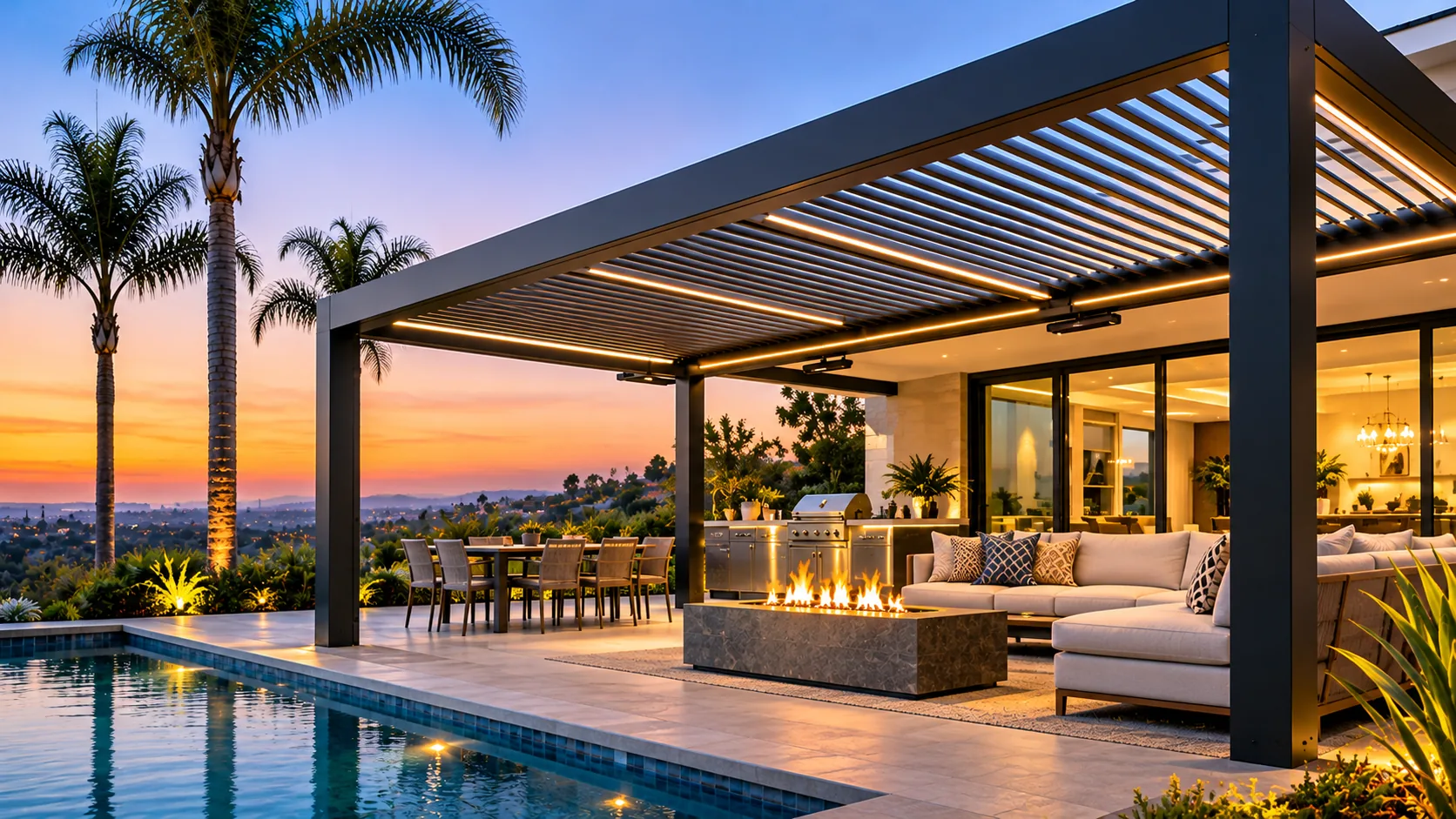
If you’re considering a motorized louvered pergola for your Orange County home, one of the first questions you probably have is whether it’s worth the investment.
My answer is that it depends on how you plan to use your outdoor space.
After more than 25 years working in construction, landscaping, remodeling, and outdoor living, I’ve learned that choosing the right patio structure starts with understanding the property, not simply selecting a product.
A homeowner who wants permanent shade over a dining area may need something very different from someone creating an outdoor kitchen, a poolside lounge, or a complete backyard entertainment space.
A motorized louvered pergola can be an excellent solution, but it isn’t necessarily the right choice for every property.
In this guide, I’ll explain the advantages, limitations, costs, and design considerations I believe Orange County homeowners should understand before making that decision.
What Is a Motorized Louvered Pergola?
A motorized louvered pergola is an outdoor structure with adjustable roof louvers that open and close using an electric motor.
Unlike a traditional solid patio cover, which provides permanent overhead coverage, a louvered system allows you to control how much sunlight and shade enters the space.
You can open the louvers to allow sunlight through, partially close them for shade and airflow, or close them to provide greater overhead coverage.
Depending on the manufacturer and system, motorized louvered pergolas may also support features such as:
- Integrated LED lighting
- Motorized privacy screens
- Ceiling fans and outdoor heaters
- Remote or app-based controls
- Weather sensors
- Integrated drainage systems
- Outdoor entertainment features
These options are part of what makes a motorized pergola different from a conventional patio cover.
For a closer look at the systems and configurations available, visit our Motorized Louvered Pergolas page.
Why Motorized Louvered Pergolas Make Sense for Many Orange County Homes
One of the advantages of living in Orange County is being able to enjoy outdoor spaces during much of the year.
But that doesn’t mean every patio experiences the same conditions.
A backyard in Irvine may receive strong afternoon sunlight, while a coastal property in Newport Beach may have different exposure, wind conditions, and architectural considerations.
The ability to adjust the roof allows a motorized pergola to respond to some of those changing conditions.
1. You Can Adjust the Shade Throughout the Day
Consider a patio that receives pleasant morning sunlight but becomes uncomfortable during the afternoon.
With a solid patio cover, the overhead coverage remains the same throughout the day.
With a motorized louvered pergola, you can adjust the louvers as the position of the sun changes.
That flexibility is valuable for homeowners who use the same outdoor area for different activities.
For example, you may want more natural light while having breakfast outside, more shade during lunch, and an open roof during the evening.
It’s important to understand, however, that overhead louvers cannot eliminate sunlight entering from every angle. Depending on the property’s orientation, additional shade solutions may be necessary.
2. Adjustable Louvers Can Improve Airflow
When designing an outdoor space, I believe ventilation deserves as much consideration as shade.
A completely solid roof provides permanent overhead coverage, but it also creates a different airflow environment than an adjustable roof.
Partially opening the louvers can allow warm air to move upward through the structure while still providing some shade.
The actual comfort level depends on the weather, roof orientation, surrounding structures, and other conditions.
That’s why the direction and placement of a pergola should be considered during the design process.
3. A Pergola Can Become Part of a Complete Outdoor Living Space
One of the most important things I’ve learned from working with outdoor environments is that the structure should complement the entire property.
A pergola doesn’t exist independently from the swimming pool, landscaping, outdoor kitchen, patio furniture, or the house itself.
All these elements influence how the space functions.
For example, a pergola covering an outdoor dining area has different requirements from one installed beside a swimming pool.
An outdoor kitchen may require additional planning for ventilation, electrical service, appliances, lighting, and traffic flow.
A poolside lounge may benefit from a design that preserves views and minimizes obstructions.
Thinking about these relationships before construction begins can prevent design compromises later.
4. Aluminum Offers a Lower-Maintenance Alternative to Wood
Many Orange County homeowners consider aluminum because they want to reduce the maintenance associated with traditional wood patio structures.
Wood can require periodic painting, staining, sealing, or refinishing, depending on its condition and exposure.
Aluminum systems with appropriate protective finishes can reduce some of those maintenance requirements.
That doesn’t mean aluminum is maintenance-free.
Louvers, drainage channels, moving components, and finishes still need appropriate cleaning and inspection according to the manufacturer’s recommendations.
For coastal homes, I would also pay attention to the selected finish, hardware, and product specifications because exposure to salt air can affect materials differently.
5. Smart Features Can Expand How You Use the Patio
A motorized pergola can be more than an adjustable roof.
Depending on the system, you may be able to incorporate integrated lighting, privacy screens, outdoor heaters, fans, and smart controls.
These features can make the outdoor area more functional in the evenings and during different seasons.
However, I recommend deciding which features you actually need before finalizing the design.
Electrical requirements, mounting locations, structural compatibility, and equipment clearances are much easier to address during planning than after installation.
What I Look at Before Recommending a Pergola Design
When evaluating an outdoor structure, there are several important considerations beyond appearance.
These details can affect the comfort, functionality, and long-term performance of the finished space.
The Position of the Sun
The first consideration is how sunlight moves across the property.
A pergola that looks perfect in a rendering may not deliver the desired shade if its orientation doesn’t account for afternoon sun.
Before selecting a design, it’s important to understand when the patio receives direct sunlight and which areas need protection.
The Location of Support Posts
Post placement is another important part of the design.
A support column in the wrong location could interrupt a walkway, obstruct a pool view, interfere with an outdoor kitchen, or reduce usable seating space.
For that reason, I believe the furniture layout and surrounding features should be considered before deciding exactly where the structure belongs.
In some situations, a cantilevered design may provide advantages by reducing the number of posts in important areas, provided the engineering and selected system support that configuration.
The Connection to the House
Not every home is suited to the same attachment method.
An attached structure may create a seamless connection between indoor and outdoor living areas, but the existing building and structural conditions must be evaluated.
A freestanding pergola may be more appropriate for a detached entertaining area, a poolside environment, or a location where attachment to the house isn’t practical.
Structural requirements should guide that decision, not appearance alone.
Electrical and Drainage Planning
Because motorized pergolas use electrical components, power supply and equipment placement should be considered early.
The same applies to lighting, heaters, screens, and other integrated features.
Drainage is equally important, especially if the homeowner expects the pergola to provide coverage during rain.
The roof system, gutters, outlets, and surrounding surfaces all influence how water is managed.
These details are essential to evaluating the complete design rather than simply comparing the appearance of different pergolas.
Are Motorized Louvered Pergolas Good for Coastal Orange County Homes?
Coastal properties often require additional attention to design, exposure, and materials.
In communities such as Newport Beach, Corona del Mar, Laguna Beach, Dana Point, San Clemente, and Huntington Beach, homeowners may prioritize preserving views, complementing the home’s architecture, and selecting finishes suited to the environment.
Aluminum can be an attractive material for coastal outdoor structures because it does not require the same maintenance as exposed wood.
However, not every aluminum pergola system performs identically in a coastal environment.
The manufacturer’s specifications, protective coatings, hardware, exposure limitations, and maintenance requirements should all be reviewed.
For homes with ocean views, structural placement is particularly important. The goal should be to create a comfortable outdoor area without unnecessarily blocking the features that make the property desirable.
You can explore our Orange County service areas for more information about the communities Alumascape serves.
Motorized Louvered Pergola vs. Solid Patio Cover: Which Would I Recommend?
This is where understanding the homeowner’s priorities becomes especially important.
I would not automatically recommend a motorized pergola simply because it offers more features.
The best solution is the one that meets the property’s needs without unnecessary complexity.
When a Motorized Louvered Pergola Makes Sense
I would consider a motorized louvered system when the homeowner wants:
- Adjustable sunlight and shade
- Greater control over airflow
- A flexible outdoor entertaining area
- A contemporary architectural design
- Integrated lighting, screens, or other features
- A roof that can adapt to different activities throughout the day
When a Solid Patio Cover May Be Better
A solid or insulated aluminum patio cover may be a better choice when the homeowner wants:
- Permanent overhead shade
- A simpler roof configuration
- Less mechanical complexity
- A straightforward covered patio
- No need for adjustable roof louvers
If the homeowner’s main objective is permanent shade, there may be little reason to invest in motorized features they won’t use.
For a more detailed comparison, read our guide to Louvered vs. Solid Patio Covers.
What Are the Disadvantages of Motorized Louvered Pergolas?
I think it’s important to discuss the limitations of a product, not just its advantages.
A motorized louvered pergola offers flexibility, but that flexibility introduces additional considerations compared with a fixed-roof structure.
Higher Initial Investment
Motorized systems generally involve more components than simpler fixed-roof patio covers.
The adjustable louvers, motors, controls, electrical work, and optional accessories can increase the overall investment.
Whether those additional features are worthwhile depends on how frequently you expect to use them.
Mechanical Components Require Maintenance
A motorized roof includes moving components that may eventually require adjustment, service, or replacement.
Homeowners should understand the manufacturer’s maintenance recommendations and warranty coverage before purchasing a system.
It’s also worth asking who handles service if a motor or control component needs attention in the future.
Rain Protection Depends on the System
One misconception worth addressing is that every closed louvered roof performs like a completely waterproof conventional roof.
Actual water resistance depends on the specific system, louver design, drainage capacity, installation quality, and weather conditions.
Some systems are engineered to manage normal rainfall when fully closed, but limitations may apply during wind-driven rain or severe weather.
Always review the manufacturer’s documented performance specifications rather than assuming all louvered roofs provide the same level of protection.
Not Every Property Needs Adjustable Louvers
A homeowner who wants a permanently covered seating area may receive better value from a solid patio cover.
Additional technology is only beneficial when it helps solve a real problem or improves how the outdoor space will be used.
How Much Does a Motorized Louvered Pergola Cost in Orange County?
Cost is one of the most important considerations, but it’s difficult to provide an accurate figure without understanding the project.
Unlike a standard product with a fixed retail price, a custom pergola installation can involve several factors that affect the final proposal.
These include:
- Dimensions and overall square footage
- Structural spans and post placement
- Attached or freestanding configuration
- Engineering and foundation requirements
- Electrical installation
- Roof system and controls
- Integrated lighting
- Privacy screens, fans, or heaters
- Drainage requirements
- Site preparation
- Permitting and HOA requirements
- Finish and accessory selections
Why Two Pergola Quotes May Be Very Different
Imagine receiving two proposals for what appears to be the same size motorized pergola.
One proposal may include structural engineering, electrical work, drainage provisions, integrated lighting, permitting, and site preparation.
The other may primarily cover the pergola structure and installation, with some additional work excluded.
Even if both proposals describe a similar pergola, they may represent very different scopes of work.
That’s why I recommend reviewing exactly what’s included, what’s excluded, and who is responsible for each part of the project.
The lowest initial quote isn’t necessarily the lowest total project cost.
For additional pricing considerations, see our Patio Cover Cost in Orange County guide.
Do Motorized Pergolas Require Permits in Orange County?
Permit requirements depend on the specific city, property, and proposed construction.
Important factors can include the structure’s dimensions, attachment method, engineering requirements, electrical work, location, and relationship to existing buildings.
Homeowners should not assume that a pergola is exempt from permitting simply because it is freestanding or has an adjustable roof.
HOA approval may also be required separately from city permitting.
Before construction begins, it’s important to determine which approvals and documentation apply to the property.
At Alumascape, our project approach can include design, engineering, permitting, installation, and final walkthrough, depending on the scope of work.
Learn more in our Patio Cover Permit Guide.
How Motorized Pergola Design Priorities Differ Across Orange County
Orange County includes a wide variety of properties, architectural styles, and outdoor environments.
The design priorities for a coastal home may differ from those of a larger inland property.
Coastal Orange County
In Newport Beach, Corona del Mar, Laguna Beach, Dana Point, and other coastal communities, preserving views, selecting appropriate materials, and integrating the structure with existing architecture can be important considerations.
South Orange County
In Mission Viejo, Laguna Niguel, San Juan Capistrano, Lake Forest, and Coto de Caza, homeowners may be planning pergolas as part of larger backyard improvements involving pools, landscaping, outdoor kitchens, and entertaining spaces.
Central and North Orange County
Properties in Irvine, Tustin, Yorba Linda, and surrounding communities may involve different considerations around contemporary design, HOA requirements, heat exposure, smart controls, and outdoor functionality.
Regardless of location, the goal should be to select a design that responds to the property’s actual conditions rather than assuming the same configuration will work everywhere.
Questions I Recommend Asking Before Hiring a Pergola Contractor
A motorized pergola is both a product purchase and a construction project.
Before committing to an installation, I recommend understanding the complete scope of work.
- Who is responsible for the design and engineering?
- Will structural or electrical permits be required?
- What preparation work is included?
- How will the pergola be attached or supported?
- How will rainwater drainage be managed?
- What electrical work is included?
- Which accessories are included in the proposal?
- What structural and component warranties apply?
- Who will handle future service or maintenance?
- Can the contractor provide examples of relevant completed projects?
- Who will coordinate the different stages of construction?
These questions can help homeowners understand what they’re purchasing and reduce misunderstandings during the project.
So, Are Motorized Louvered Pergolas Worth the Investment?
For homeowners who value adjustable shade, airflow, modern design, and the ability to integrate outdoor-living features, a motorized louvered pergola can be a worthwhile investment.
But I wouldn’t recommend one to every homeowner.
If all you need is permanent shade over a simple patio, a solid or insulated aluminum patio cover may provide a better balance of functionality, complexity, and cost.
On the other hand, if you’re creating a complete outdoor entertaining area, a motorized louvered pergola may provide the flexibility you’re looking for.
The decision should come down to three questions:
- How will you use the outdoor space? Consider how often you’ll use it and what activities it needs to accommodate.
- Which features will genuinely improve your experience? Adjustable shade, lighting, screens, and smart controls are only valuable if they support your lifestyle.
- Does the structure work with your property? Orientation, engineering, post placement, drainage, architecture, and surrounding features should all influence the final design.
My recommendation is to begin with the property and the way you want to live outdoors, then choose the structure that best supports those goals.
That’s a much better starting point than selecting a pergola based on appearance or features alone.
Frequently Asked Questions About Motorized Louvered Pergolas
Are motorized louvered pergolas waterproof?
Water resistance depends on the specific system, roof configuration, drainage design, installation, and weather conditions. Some systems are designed to manage normal rainfall when closed, but homeowners should review the manufacturer’s specifications and limitations before relying on the roof for rain protection.
Can a motorized pergola be attached to a house?
Many systems support attached and freestanding configurations. The appropriate option depends on the existing building, structural conditions, engineering, and proposed design.
Are motorized pergolas suitable for coastal homes?
They can be, provided the selected system and materials are appropriate for the property’s exposure and environmental conditions. Coastal installations require attention to finishes, hardware, maintenance, engineering, and manufacturer specifications.
Do motorized pergolas increase property value?
A well-designed outdoor structure may improve the usability and appeal of a property, but a specific increase in market value or return on investment cannot be guaranteed. Value depends on the property, local market, project quality, cost, and buyer preferences.
How long does motorized pergola installation take?
The timeline depends on design complexity, engineering, permits, material availability, electrical work, site preparation, and the installation itself. A custom project may require several separate stages before construction is completed.
Can lighting, heaters, and privacy screens be added?
Depending on the selected system and design, integrated lighting, heaters, fans, privacy screens, and other outdoor features may be available. Compatibility should be confirmed before the project is finalized.
Is a motorized pergola better than a solid patio cover?
Not necessarily. A motorized pergola provides adjustable shade and airflow, while a solid patio cover provides permanent overhead coverage with less mechanical complexity. The best option depends on the homeowner’s needs and the property’s conditions.
For additional guidance, read our Louvered vs. Solid Patio Covers comparison.